
The AI-Ready Library
Open, ethical AI infrastructure—built collaboratively for higher education
PALNI libraries are poised to design a shared, open AI ecosystem that strengthens student learning, protects institutional values, and ensures equitable access to emerging technologies. Representing 23 academic institutions, PALNI is positioning the library not simply as a repository of information, but as a central hub for AI literacy, discovery, and stewardship—work that will benefit students, faculty, and higher education well into the future.

Why AI requires a library-led approach
Artificial intelligence is rapidly reshaping how students learn, how faculty teach, and how institutions manage information. While AI offers enormous promise, it also introduces real risks—particularly for smaller institutions without the resources to build proprietary systems or evaluate commercial tools.
Libraries are uniquely positioned to lead in this moment. With longstanding expertise in information literacy, ethics, privacy, and shared infrastructure, libraries provide trusted, mission-aligned pathways for integrating AI into academic life.
Libraries are already leading
National research consistently identifies libraries as essential partners in AI readiness. The EDUCAUSE Horizon Action Plan highlights AI literacy, ethical use, and data governance as near-term priorities for higher education—areas where libraries already play a central role. Organizations such as the Association of College & Research Libraries, the Coalition for Networked Information, and the Association of Research Libraries further emphasize libraries’ responsibility for guiding responsible, equitable adoption of AI technologies.
"PALNI builds on this foundation by advancing AI work collectively, reducing duplication, lowering costs, and ensuring that values-driven infrastructure remains accessible to all supported institutions."
How PALNI Can Make a Difference
A consortial approach makes responsible AI possible at scale. PALNI libraries work to enable:
Shared infrastructure
Collaborative, open infrastructure governed by academic values.
Reduced costs and duplication
Less reliance on expensive vendor services and commercial tools.
Security and local governance
Stronger data privacy and institutional control over information.
Scalable innovation
Which especially benefits small and mid-sized academic institutions.
Addressing Key Gaps in the AI Transition
The Efficiency Gap: Metadata and Access
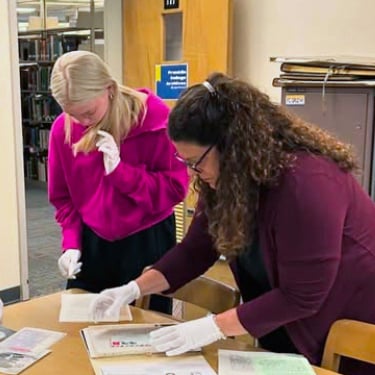
Challenge: Libraries hold vast digital and archival collections that remain undiscoverable due to the high cost of manual metadata creation.
Opportunity: PALNI can explore the integration of local, privacy-preserving AI tools to automate descriptive metadata and accessibility features such as alt-text—unlocking these collections for students, researchers, and the public.
Impact: Increased discovery of unique institutional collections, enhanced accessibility, and hands-on student engagement with ethical AI use.

The Discovery Gap: Student Experience
Challenge: Students increasingly expect to search using natural language, while traditional catalogs rely on keyword-based systems.
Opportunity: PALNI could develop AI-powered discovery tools that allow students to query trusted library collections using natural language in a secure environment designed to return accurate, source-based results.
Impact: Improved student engagement, deeper research experiences, and greater confidence in the reliability of information sources.

The Literacy Gap: Critical and Ethical Use
Challenge: Faculty express concern about AI’s impact on critical thinking, while students need guidance on ethical and responsible use.
Opportunity: PALNI libraries could develop a shared, modular AI literacy curriculum that can be embedded into campus learning environments and adapted locally.
Impact: Students graduate with verified competencies in ethical AI use, critical evaluation, and digital fluency.
What This Work Would Enable
A sustainable, shared AI infrastructure that benefits students today and higher education long-term.
Immediate Benefits
-
Trusted content
Expanded access to trusted academic content
-
Better discovery
Improved student and faculty research and discovery experiences
-
Improved privacy
Stronger protections for privacy and intellectual property
-
Lower costs
Reduced institutional costs through shared infrastructure
Long-Term Outcomes
-
Equitable access
A more equitable AI landscape across higher education
-
Open infrastructure
Sustainable, community-governed alternatives to commercial platforms
-
AI-ready graduates
Graduates prepared to navigate AI critically
-
Replicable model
A model that can be adopted by other academic libraries
A Practical, Collaborative Model
PALNI’s work shows how libraries can support thoughtful, responsible uses of AI through shared infrastructure and collaboration. By investing in staff expertise, open systems, and community-informed design, this initiative offers a realistic model for institutions looking to integrate AI in ways that align with teaching, learning, and long-term stewardship.
For more about PALNI’s AI initiatives or to discuss partnership or funding opportunities, email Kirsten Leonard, PALNI Executive Director.